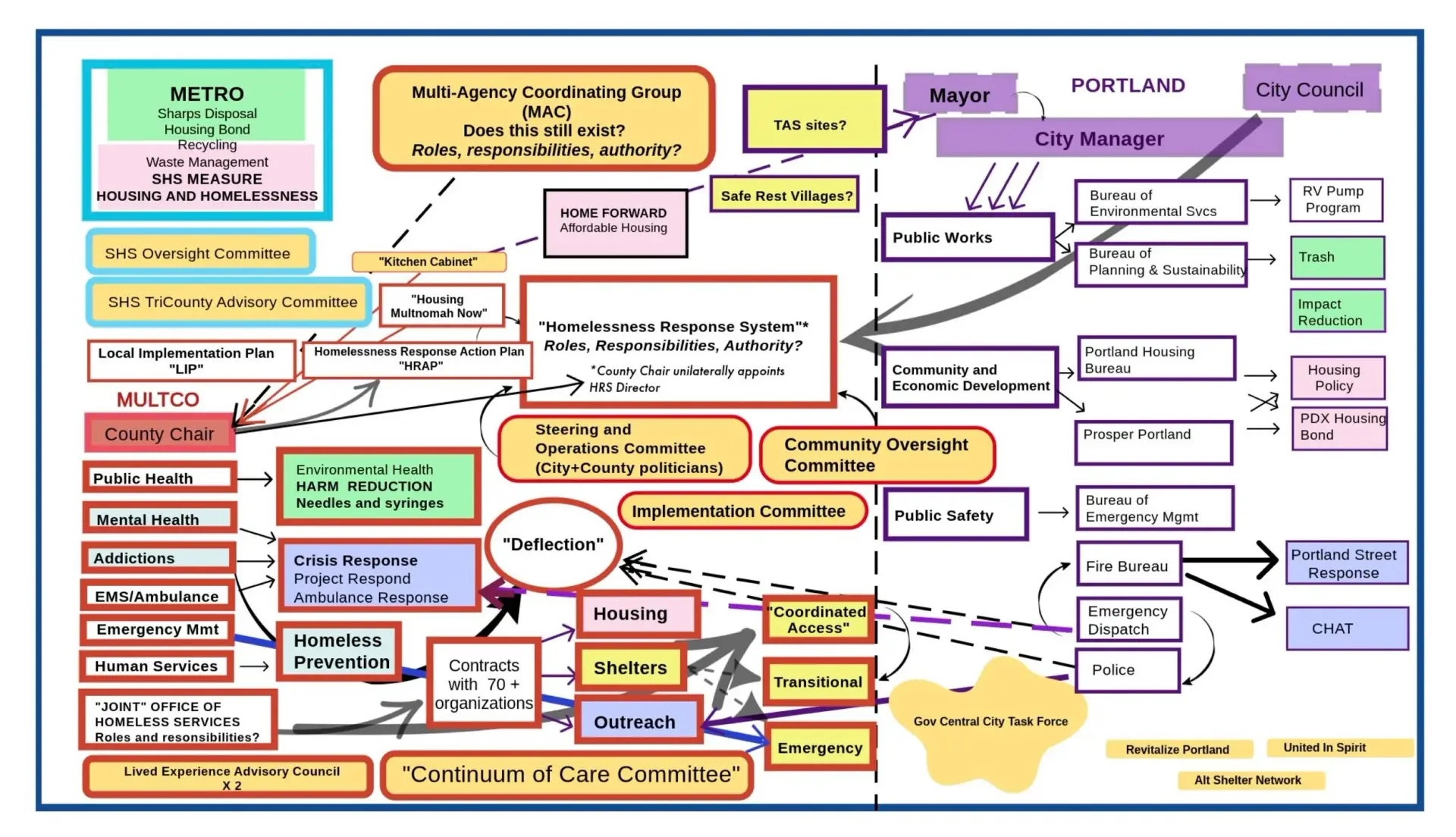
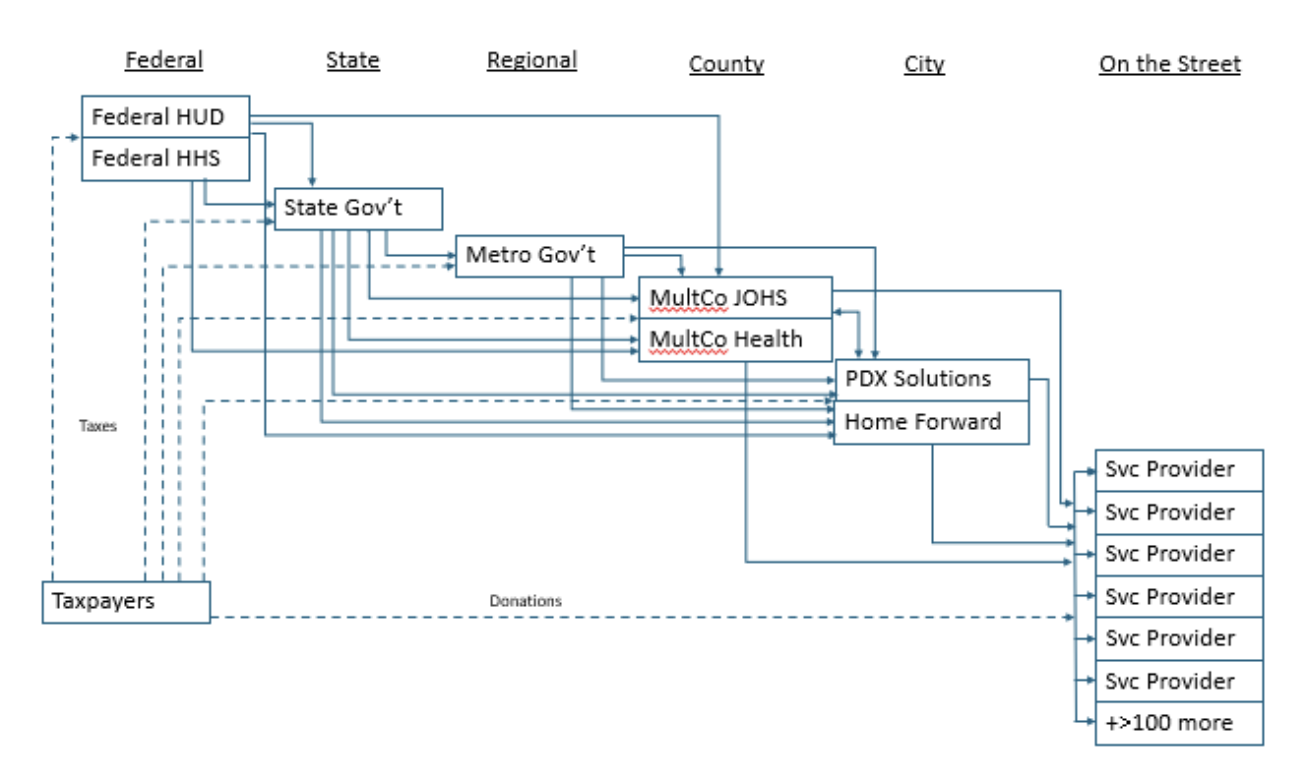
As you can see, the money flows from the taxpayers through many different layers of government through many different funding streams, before finally reaching the non-profit service providers that actually work with the homeless. It is very difficult to quantify the dollars in each funding stream, but see the Blog by Michael Royce, “Where Does the Money Come From?”.
Each layer of government has its own overheads, which create their own goals and requirements attached to the funding it provides to the next layer. What the higher levels of government—the providers of the funds-- perceive as important gets more attention than feedback from the street.
The result? The county funds some shelters, the city funds a few, too. The county pays providers to hand out tents and tarps and needles and straws, the city pays providers to pick them up. The county spends a lot on supported housing services, but only 11% of the clients are actually homeless. The city also funds subsidized housing, sometimes in conjunction with the county, sometimes on its own.
Nobody seems to track the results in the behavioral health system, which is the key to solving the homeless addiction crisis, because it is funded and managed by separate bureaucracies. The city’s police and fire departments spend between a third and half of their time dealing with the homeless.
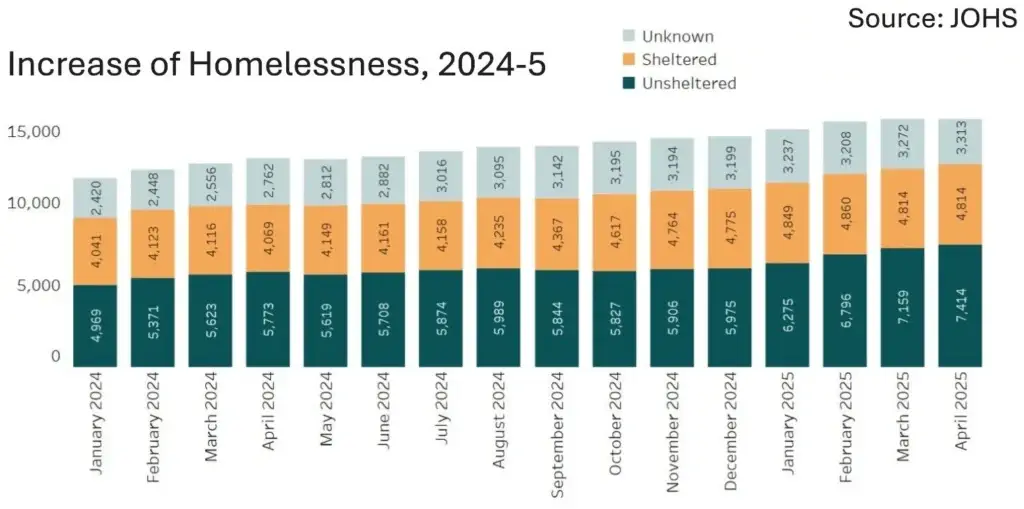
Only in the last month have we had a current count of the number of homeless, but we still have little knowledge of their individual conditions or treatment needs, and we have no way to track the help they do receive across the numerous providers. Without this crucial information we cannot create a true By-Name List, which is a vital tool for managing the individual’s recovery from homelessness and for planning and allocating the resources needed to provide the necessary services.
The only way such a disjointed system can have good results is with strong political leadership and a coherent plan. Both have been sorely lacking. Reading the press releases and reports, the county’s “plan” can be summarized as “how much money do we have? Let’s spend it”. The city is little better, spending its time and resources responding to citizen complaints, with little left to address the underlying problems.
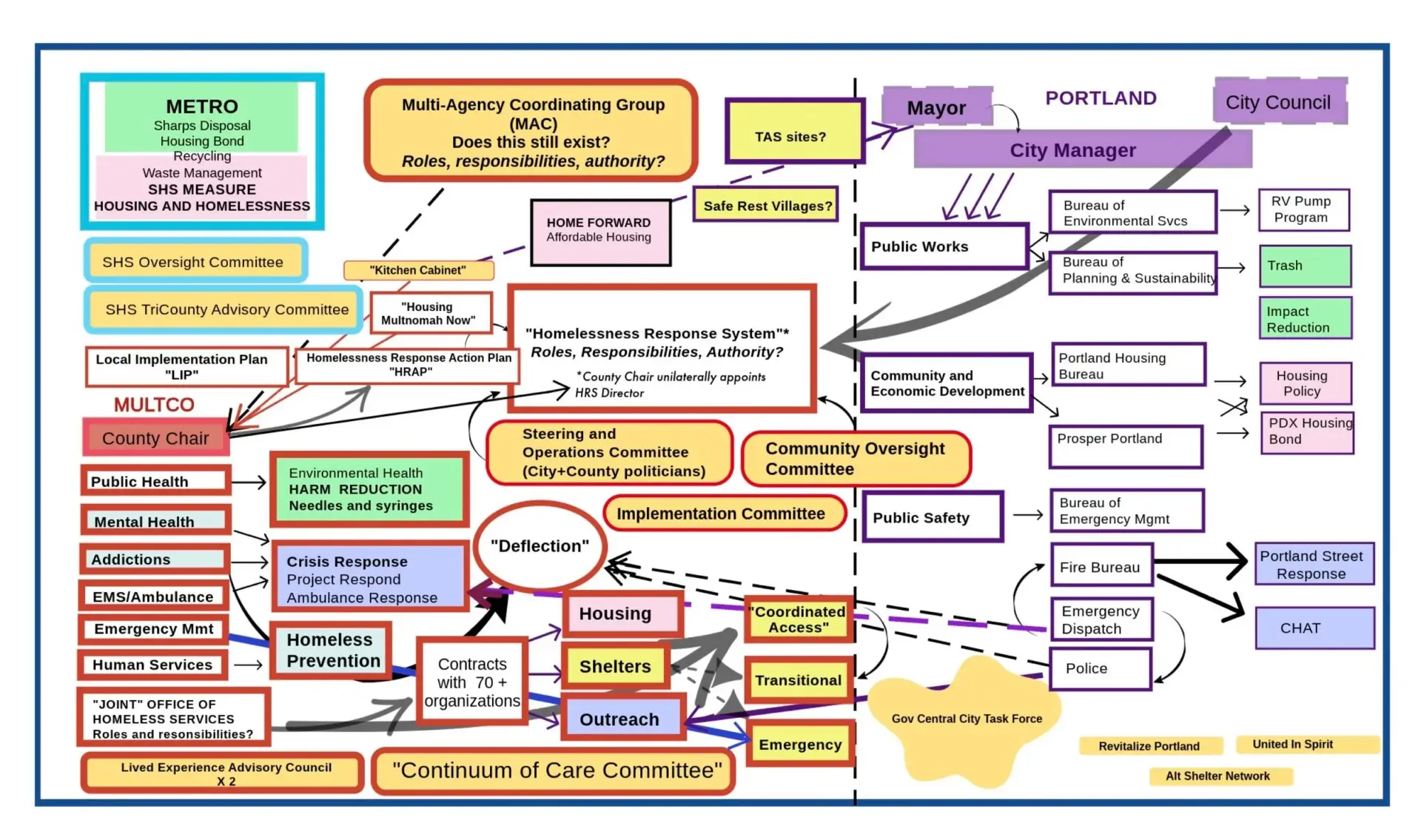
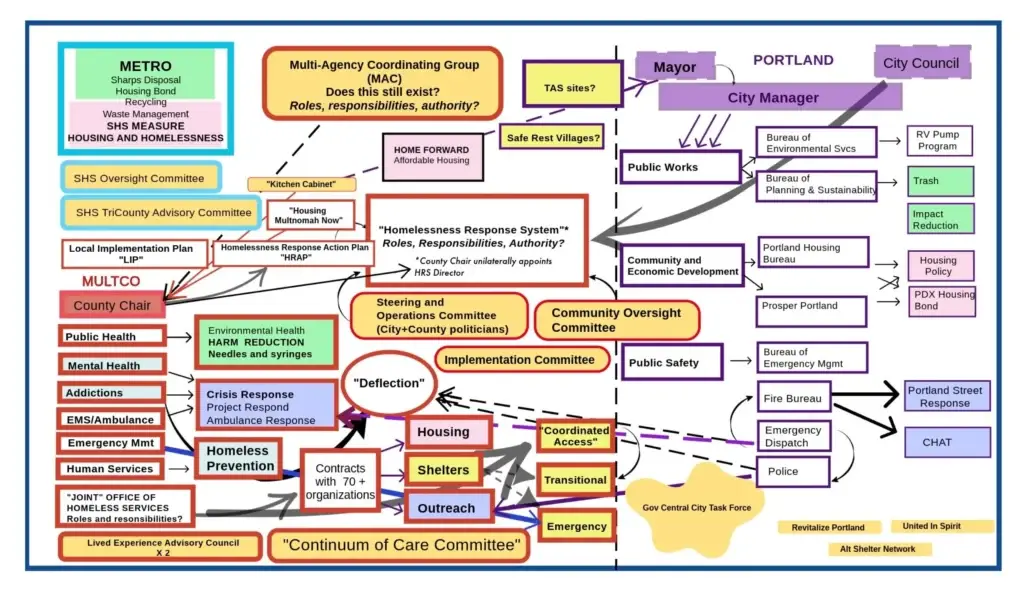
There is no common plan for unifying all the different organizational efforts to deal with homelessness on a County-wide or City-wide level; no single leadership body responsible for the development of a unified plan; poor coordination and inadequate data on the number, situation and needs of the homeless; and no effective quantitative measurement of results achieved by the non-profit service providers. As should be no surprise, progress has been slow. Many would say progress has been non-existent.
In the future there will be significantly less money available due to social spending cuts by the current administration. The county plans to continue with its current policies, but with less money. That is a recipe for failure. The city’s new mayor has a shelter plan that addresses at least one part of the problem, but more steps will be necessary.
We must rethink and reorganize our approach to handling this crisis.
Solutions?
We have seen two proposed solutions. One was developed by Sharon Meieran, a former county commissioner and field ER doctor, linked here. It is long, but well worth reading. Another white paper, by Ken Thrasher of the Homeless Solutions Coalition, is linked here.
Both proposals include:
Coordinating government agencies
Coordinating service providers
Holding both government agencies and service providers accountable for results
Spending more money has not fixed our homelessness crisis. Spending it smarter can.
Works cited can be found here.